
Petty cash for small daily shop expenses
Tea, rickshaw fare, a roll of tape, a small repair: these spends are too small to write down and too many to ignore. Keep a fixed petty cash float, take a slip for every spend, and top up once a week against the slips. In a made-up example, a float of 2,000 gives you a clear weekly number and no mystery gap in the drawer.
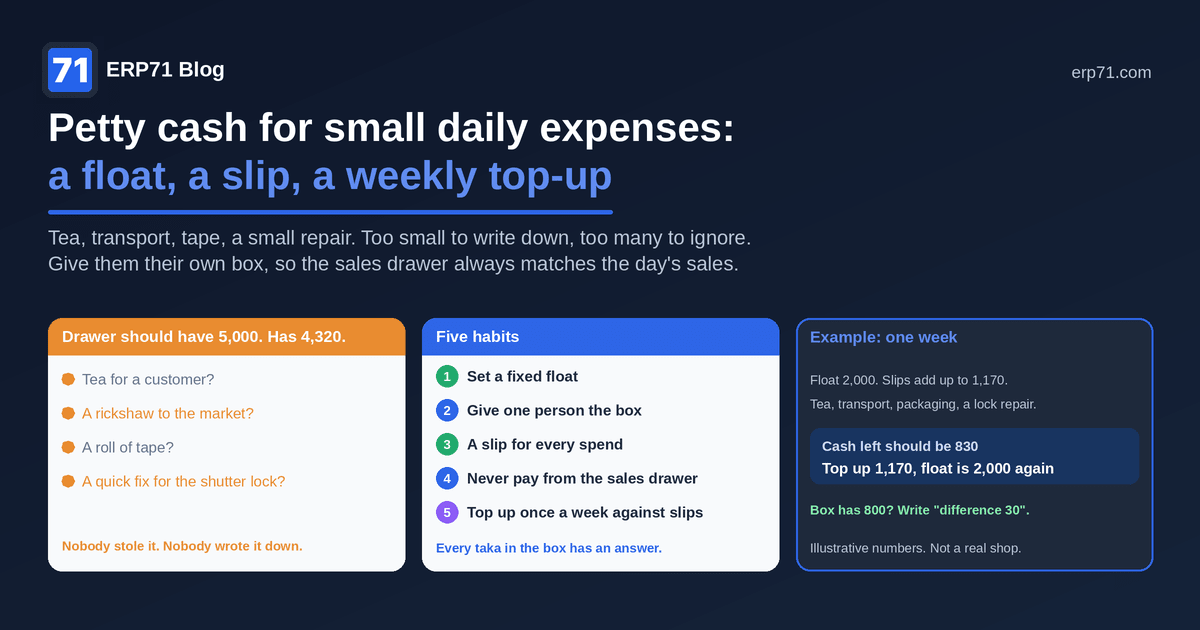
The drawer should have 5,000. It has 4,320.
Nobody stole it. It went on tea for a customer, a rickshaw to the market, a roll of tape and a quick fix for the shutter lock. Each one was small, so nobody wrote it down.
Add up a month of that and it is real money with no record.
Why small spends slip through
A small spend feels too small to record. So it comes out of the sales drawer, and the day's cash no longer matches the day's sales.
Then the owner cannot tell whether the gap is a petty spend, a wrong change, or a missing sale (cash in the drawer vs the bank).
The fix is not to ban small spends. Shops need them. The fix is to give them their own pocket of money.
Five habits for petty cash
A fixed float, a slip for every spend, one top-up a week.
1. Set a fixed float.
Pick one amount that covers a normal week of small spends. Take it out of the drawer once and keep it in a separate box or envelope. That amount never changes unless you decide to change it.
2. Give one person the box.
One person per shift holds it and hands it over at the end of the shift (a one-shift handover notebook). If everyone dips in, nobody is responsible.
3. A slip for every spend.
Tea, transport, packaging, small repairs: write a slip each time with the date, what it was for, and the amount. A page torn from a small notebook is fine. If there is a shop receipt, pin it to the slip. If not, the slip is the record.
4. Never pay from the sales drawer.
If the box is empty, the box gets topped up. Do not borrow from sales "just this once". That is how the two numbers get mixed again.
5. Top up once a week against the slips.
At a fixed time each week, count the cash left and add up the slips. Cash left plus slips should equal the float. Then refill the box back to the float, using exactly the amount the slips add up to.
A made-up example
Say your float is 2,000. This week the slips add up to: tea 260, transport 340, packaging tape and bags 420, a small lock repair 150. That is 1,170 in total.
The cash left in the box should be 830. If it is, you take 1,170 from the drawer, put it in the box, and the float is back to 2,000.
If the box has 800, you are 30 short. That is small, and now you can see it. Write "difference 30" and move on. If the gap grows week after week, you know where to look.
Sort the slips into a few groups
At the end of the month, sort the week's slips into a few simple groups: tea and snacks, transport, packaging, repairs, other.
You will often find one group is bigger than you thought. That is not a reason to cut it. It is a reason to know it, and to count it as a real cost of running the shop, the same way you count rent and salaries (a simple month-end close).
Keep personal and household spends out of this box (owner's draw: household vs shop money).
What this is not
It is not for big spends. Supplier payments, rent and salaries should go through the book on their own, not through the petty cash box.
And it is not about distrust. A fixed float with slips protects the person holding the box, because every taka has an answer.
Soft close
Petty cash is easiest when the weekly top-up is entered the same day, as an expense with a category. Tools like ERP71 let you record small expenses beside sales, so the weekly number is one list, not a pile of paper slips.
Start this week. Set a float, pick one person, and write the first slip today.
See it on your own shop's data. Book a free 15-min demo on WhatsApp: https://app.erp71.com/s/cnyj3p