
Owner's draw: keep household money and shop money apart
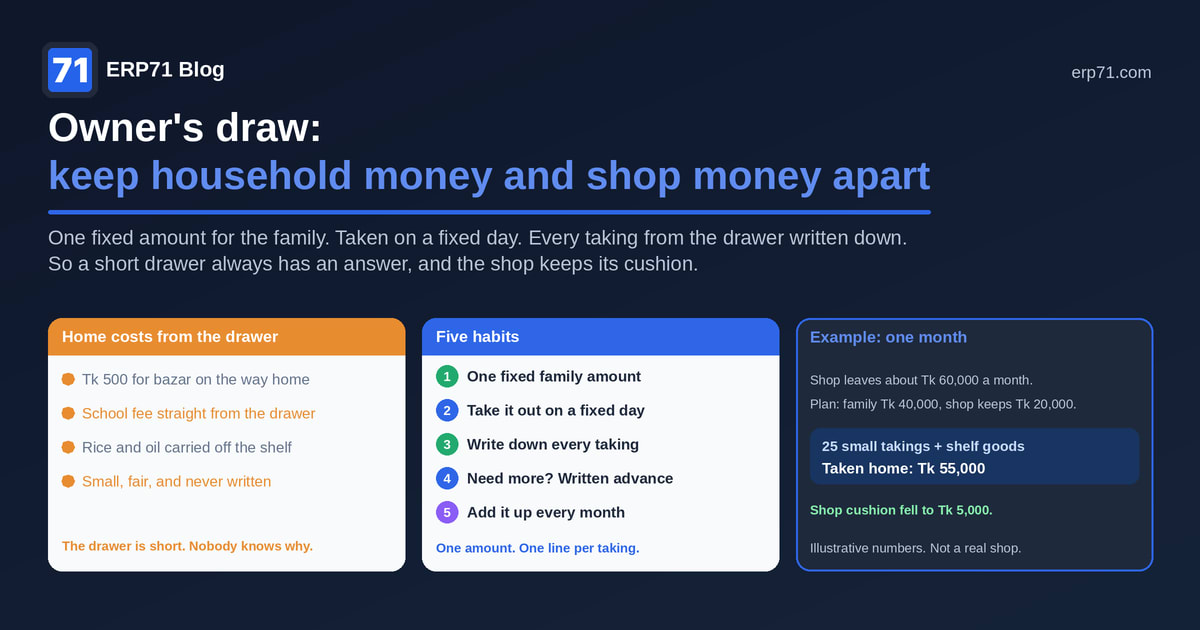
When home costs come straight out of the drawer, the shop looks like it is losing money when it is not. In a made-up example, a family plan of ৳40,000 a month quietly became ৳55,000 in small takings. Fix one monthly amount for the family, take it out in one go, and write down every taking from the drawer, even ৳200.
It is the 25th of the month. A supplier is due, and the drawer is short again.
Sales were fine. You did not buy anything big. So where did the money go?
In many family shops, part of the answer is at home. ৳500 for the bazar on the way back. ৳3,000 for a school fee. A packet of rice and two bottles of oil carried home from the shelf. Each one is small and fair. Nobody writes them down.
Why mixing the two goes wrong
The shop pays for the family. That is the point of running it. The trouble is taking it in small pieces, at any time, without a record.
You stop knowing how the shop is really doing. When the drawer is short, you cannot tell if the shop had a bad month or the home had an expensive one.
The cash count never matches. Every evening the drawer is a little less than the day's sales, and after a while you stop asking why (cash in the drawer is not money in the bank).
The shop's cushion disappears. The money meant for stock, supplier dues and slow months goes to home costs one note at a time.
A made-up example in round numbers. Say your shop leaves about ৳60,000 a month after rent, salaries, bills and supplier payments. You decide the family gets ৳40,000, and ৳20,000 stays in the shop as a cushion.
Now the month without a plan. At month end, from memory and a few scraps of paper, you count about 25 small takings from the drawer: ৳52,000 in total. Add about ৳3,000 of goods taken home from the shelf.
That is ৳55,000 out, against ৳40,000 planned. The ৳20,000 cushion is now ৳5,000, and the supplier due on the 25th has nowhere to come from. The shop was not losing money. The home was quietly spending it.
Five habits to keep household money and shop money apart
One fixed amount, one line in the book for every taking.
1. Fix one monthly amount for the family.
Base it on what the shop really leaves after its costs in a normal month, not on your best month's sales. If you are not sure, start a little lower. The shop has to cover its own costs first (your daily break-even), and the family amount comes from what is left.
2. Take it out in one go, on a fixed day.
Once a month, or twice, say the 1st and the 15th. Move it to a separate household account, mobile wallet or envelope. From then on, home costs are paid from the household money, not from the drawer.
3. Write down every taking from the drawer.
If you do take cash from the drawer, write one line in the cash book: date, amount, "home", and what it was for. Do the same when you carry goods home from the shelf, at the buying price. Even ৳200. It is the same rule you would want for a staff advance (staff advances and salary records).
4. If home needs more, take it as an advance, in writing.
A wedding, a doctor, a family emergency: it happens. Take what you need, write it down as an advance against next month's family amount, and take that much less next month. An extra taking that is written is a decision. One that is not written is a leak.
5. Once a month, add it up.
At month end (a simple month-end close), add up everything taken for home, from the drawer and from the shelf, and compare it with the fixed amount. If you are always over, adjust the amount after two or three months, not after one bad week.
What this is not
It is not about paying yourself less. You work long hours, and the family should get a fair amount. The point is to know what that amount is.
It is not tax or accounting advice. It is a simple habit to keep the shop's cash and the home's cash from blurring together, so you can see each one clearly (what real accounting means for one shop).
And it is not about distrust inside the family. A written line protects everyone, including the person who took the money, from "where did it go?" arguments later. Use the example only to see the pattern, then write down your own numbers.
Soft close
When every taking from the drawer is entered as its own line, the family amount sits next to sales, costs and supplier payments, and a short drawer has an answer the same evening. Tools like ERP71 are built for that kind of one-shop clarity: what the shop earned, what went home, and what is left for the shop.
Start this month. Pick your family amount, pick the day you take it, and put a small notebook next to the drawer for anything taken in between. At the end of the month you will know exactly where the money went.