
Stock count without closing the shop: one shelf a day
A full stock count means closing the shop for a day, so most owners skip it and the book drifts away from the shelf. Count one shelf a day instead, before opening, and fix the gaps the same morning. In a made-up example, 25 shelves take about 25 working days, so the whole shop is checked once a month without one lost sale.
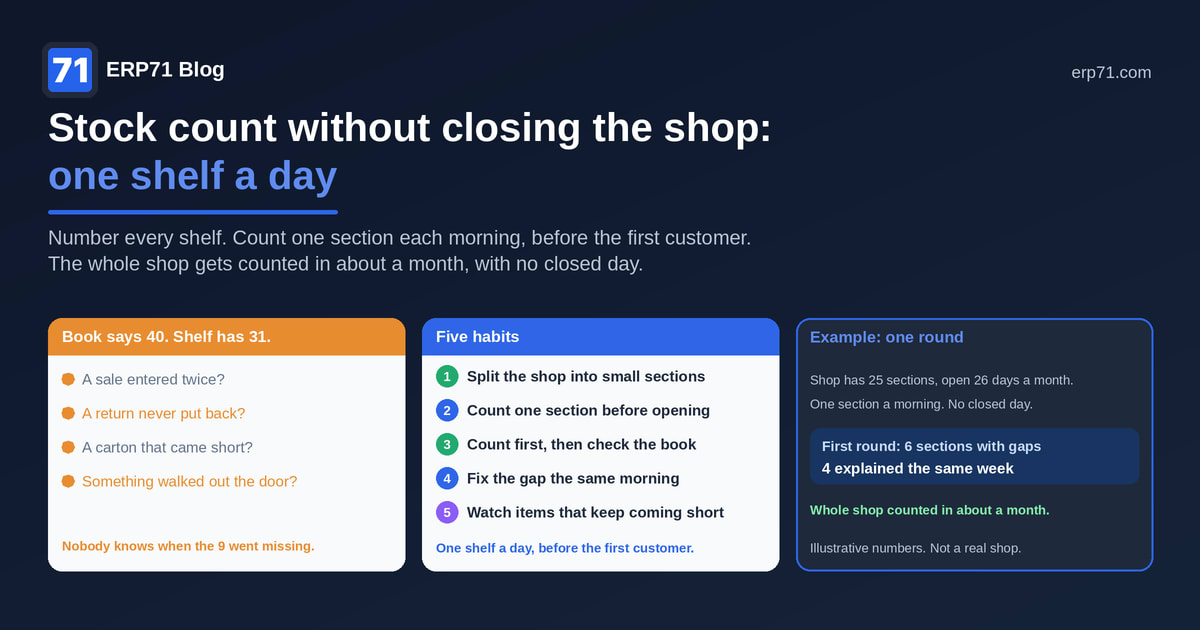
The book says 40 packets. The shelf has 31.
Nobody knows when the 9 went missing. It could be a sale entered twice, a return never put back, a carton that came short, or something that walked out of the door.
The only way to know is to count. And most shops never do, because a full count means shutters down for a day.
Why the yearly count does not work
Closing for a day costs a day of sales. So the count gets pushed to Eid, or to the end of the year, or to never.
When it finally happens, the gap is months old. You find the shortfall, but you cannot find the cause. The memos are gone and nobody remembers that week.
In between, you order from the book, not from the shelf. You reorder things you still have and run out of things the book says are there (stockouts and overstock both kill cash).
Five habits for a rolling count
One shelf a day, before the first customer.
1. Split the shop into small sections.
Give every shelf, rack or cupboard a number. A section should take 10 to 15 minutes to count. Big racks can be split into top and bottom.
2. Count one section each morning, before opening.
Same time every day, so it becomes routine like opening the shutter. If you have staff, rotate who counts. A different pair of eyes catches different things.
3. Write down what you count, not what you expect.
Take a printed list of the section with the item names and leave the quantity column blank. Count first, then compare with the book. If you look at the book first, you will "find" the number you expect.
4. Fix the gap the same morning.
For each difference, check the last few days: sales, returns, purchases, damaged stock (returns and damaged stock). If you find the reason, correct the entry. If you do not, adjust the book to the shelf and write one line: date, item, how many, "count difference".
5. Watch the items that keep coming up short.
If the same items show a gap every month, that is your signal. Small, costly items near the counter usually need a closer look than big cartons at the back (a 10-minute weekly shelf check).
A made-up example
Say your shop has 25 sections and is open 26 days a month. One section a morning means the whole shop is counted in about a month, with no closed day.
In the first round, suppose 6 sections show gaps. You find the cause for 4 of them the same week: two returns never entered and two sales typed twice. The other 2 you adjust and mark.
By the second round, the gaps are smaller, because they are only a month old and the staff know the shelf will be counted. That is the real benefit: a gap you find in 30 days is still a gap you can explain.
What this is not
It is not a replacement for a full count when you need one, for example before selling the business or changing the whole system. It is a way to keep the book close to the shelf in between.
And it is not about suspecting staff. Most gaps are entry mistakes. A regular count protects the person on the counter too, because a gap found early has an answer.
Soft close
A rolling count is easiest when the book is always up to date: every sale, purchase, return and adjustment entered on the day. Tools like ERP71 keep stock moving with every memo, so the morning count is a quick compare, not an evening of searching through notebooks (a simple month-end close).
Start tomorrow morning. Number your shelves tonight, print the list for section 1, and count it before you open.
See it on your own shop's data. Book a free 15-min demo on WhatsApp: https://app.erp71.com/s/4hv3t9