
Expiry and slow stock: a 10-minute weekly shelf check
Expiry and dead stock do not announce themselves. They sit at the back until a customer finds a near-dated pack, a supplier rejects a return, or festival leftovers quietly eat cash. Here is a 10-minute weekly shelf check with four habits: walk the same path, tag sell soon / return-swap / dump, act the same week, and feed the next purchase order from the sheet.
Expiry and dead stock do not announce themselves. They sit at the back of the shelf, behind the fast movers, until something goes wrong.
A customer picks a cream and notices the date. A supplier refuses a return because the window has closed. Festival leftovers sit for months and quietly eat cash that should have restocked winners (stockouts and overstock).
Owners invent one-off rules under pressure. Staff guess. The cash is already gone.
This is not about throwing stock away every week. It is about a short, same-day walk so near-dated and slow items get a decision while you still have options.
Why expiry and slow stock hide until cash is gone
Fast movers get the front of the shelf. Slow and near-dated packs drift to the back. Nobody looks there unless a customer complains or month end forces a dump (simple month-end close).
Pharmacy, grocery and cosmetics feel this hardest. Clothing feels it after a season. In every case the pattern is the same: the problem was visible weeks earlier, but nobody had a habit of looking.
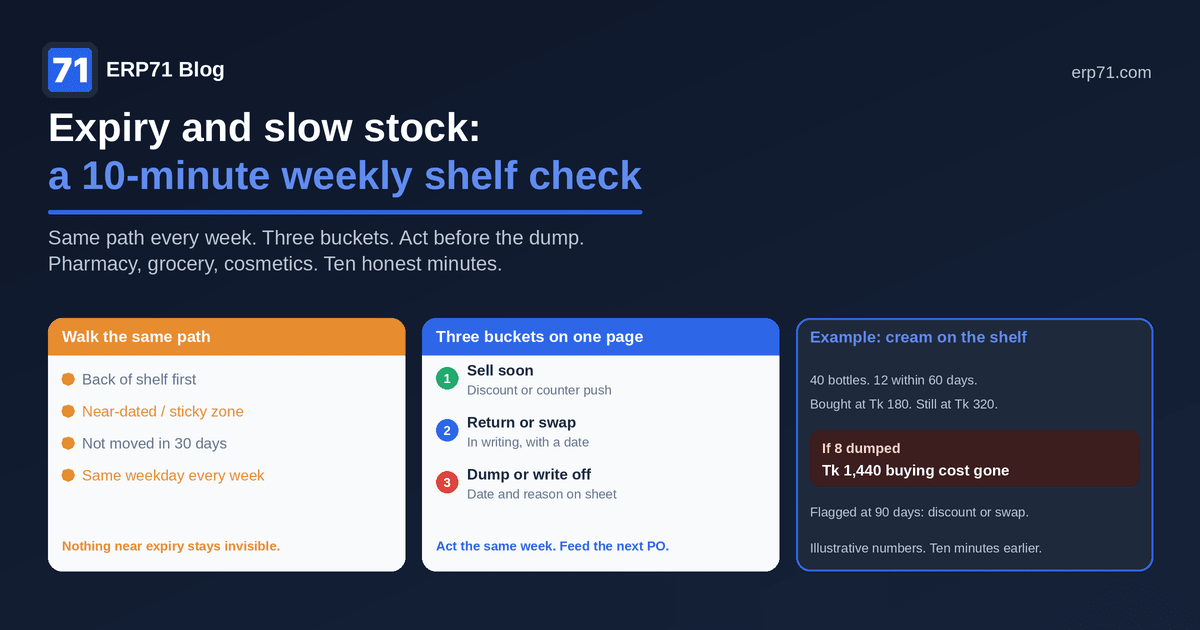
An example with made-up round numbers: a cosmetics shelf has 40 bottles of a cream. Twelve are within 60 days of expiry. The owner bought them eight months ago for ৳180 each and still prices them at ৳320.
If eight go unsold and get dumped, that is ৳1,440 of buying cost gone, plus shelf space that could have held a faster item. A 10-minute weekly walk would have flagged those bottles at 90 days out, when a small discount or a supplier swap was still possible (returns and damaged stock).
The same trap hits quiet earners you meant to push and never did (best seller vs best earner). Volume looks fine. The shelf holds cash that is not turning.
Four habits for a 10-minute weekly shelf check
You need one page, the same weekday every week, and ten honest minutes.
1. Walk the same path every week.
Start at the back of the shelf, not the front. Check the sticky or near-dated zone. Then the items that have not moved in about 30 days. Same route, same day. The point is that nothing near expiry or stuck stays invisible for another month.
2. Tag three buckets on a one-page sheet.
Sell soon: discount or counter push this week. Return or swap with the supplier: get it in writing, with a date. Dump or write off: date and reason on the sheet. Three columns are enough. Do not invent a fourth rule under pressure.
3. Act the same week, not "after Eid".
Mark the discount on the memo. Call the supplier once. Move dump items off the selling shelf so nobody sells a near-dated pack by mistake. Waiting for a quieter week is how 90 days becomes 30 days becomes a refuse (returns and damaged stock).
4. Feed the next purchase order from the sheet.
Do not reorder what just sat. Cut the quantity or change the pack size. Restock what emptied and earned. The weekly sheet should talk to the next order, not sit in a drawer (purchase orders).
What this is not
It is not a full stock audit. You are not counting every SKU. You are walking the risk zones: near-dated, sticky, and slow.
It is also not a reason to dump everything that looks slow. Some items turn slowly but pay well. Keep those on purpose, with a clear note. The weekly check is so the keep and the dump are choices, not surprises at month end (what real accounting means for one shop).
Soft close
When every batch, expiry and sale sits in one place, the weekly shelf check is a short walk with a list, not a surprise dump at month end. Tools like ERP71 are built for that kind of one-shop clarity: what is near expiry, what has not moved, and what you decided to sell, return or write off.
Pick one weekday this week. Print or draw one page with three buckets. Walk the back of the shelf first. Ten minutes now beats ৳1,440 of cream in the bin later.