
Delivery orders that lose money: fee, minimum or a polite no
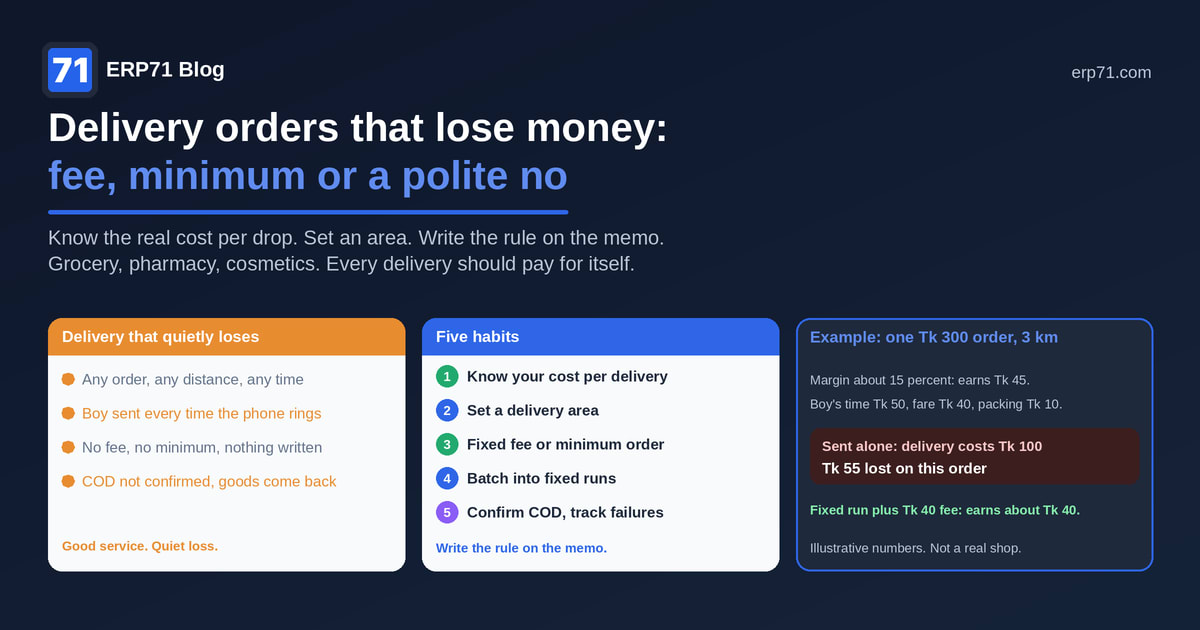
A ৳300 order delivered 3 km away can cost more than it earns once you count the boy's time, the fare, the packaging and the cash on delivery risk. Five habits fix it: know your real cost per delivery, set a delivery area, use a fixed fee or a minimum order written on the memo, batch deliveries into fixed runs, and confirm COD orders before dispatch.
A customer calls at 7 in the evening. Two packets of milk, a dozen eggs and a bar of soap. "Bhai, please send it, I am at home." The total is ৳300 and the house is about 3 km away.
You say yes. Your boy takes a rickshaw, waits at the gate, and comes back forty minutes later.
But did that order make money? Delivery feels like good service, and it is. It can also be the quiet place where your profit goes.
This is not about refusing customers. It is about simple rules so every delivery pays for itself.
Why a small delivery can cost more than it earns
On the memo, the order is ৳300. But you only keep the margin, the gap between what you paid for the goods and what you sold them for (your best seller may not be your best earner).
A made-up example in round numbers. Say your margin on that basket is about 15 percent, so the order earns you ৳45.
Now the delivery. Your boy is gone for most of an hour. If you pay him ৳12,000 a month, that hour is worth roughly ৳50 of his salary. Rickshaw fare or fuel both ways, say ৳40. A bag, tape and a box for the eggs, ৳10. That is ৳100 to deliver an order that earns ৳45. You are ৳55 down before anyone says thank you.
Then there is cash on delivery (COD). Sometimes the customer is not home or changes their mind. The boy comes back with the goods and no money, the eggs may be cracked, and the next attempt costs another ৳100.
Sometimes he does collect, but the cash comes back short or a day late. That is a due sale by another name (due sales that never get collected).
One order like this is nothing. Ten a day is a real hole that never shows on the memo.
Five habits that stop delivery from eating your profit
One rough number and a few written rules are enough.
1. Know your real cost per delivery.
For one week, note every delivery: where, how long, fare or fuel, packaging. Add the boy's time and divide by the number of drops. Even a rough average shows which orders are worth sending alone.
2. Set a delivery area, in simple zones.
Draw a small circle around the shop. Inside it, normal delivery. A bit further, only with a fee or on fixed runs. Beyond that, politely say no, or offer a courier at the customer's cost. A clear no is better than a delivery you quietly pay for.
3. A fixed delivery fee, or a minimum order for free delivery.
Pick one simple rule. For example: ৳40 delivery fee inside the area, free delivery on orders of ৳1,000 or more. Write it on the memo, on your Facebook page and in your WhatsApp status. When the rule is written down, nobody argues with your boy at the door.
4. Batch deliveries into fixed runs.
Instead of sending the boy every time the phone rings, run deliveries at fixed times, say 11 am, 4 pm and 8 pm, grouped by area. In our made-up numbers, four drops on one run share the fare and the time, and the cost per drop falls to about ৳45. The same ৳300 order with a ৳40 fee now earns a little instead of losing.
5. Confirm COD orders, and track every failed delivery.
Before dispatch, call back to confirm the address and the total including the fee. For a new customer far away, ask for payment first by bKash or Nagad. Keep one page for failed deliveries and returns: date, customer, reason, and anything that came back damaged (returns and damaged stock without a fight). Check the COD cash the boy brings back against the memos before it goes in the drawer (cash in drawer vs bank).
What this is not
It is not about being stingy with regulars. An elderly neighbour, or a family that buys from you every week, may deserve free delivery. That is fine, as long as you choose it rather than drift into it.
It is not about copying anyone's rates either. Use the example only to see the pattern, then do the sum with your own figures.
And sometimes the right answer is no. A ৳150 order from across town at 10 at night is not good service if it makes your shop poorer.
Soft close
When every order carries its delivery fee, its run and its COD status, you can see at closing which deliveries earned and which only cost money. Tools like ERP71 are built for that kind of one-shop clarity: what was sold, what went out for delivery, and what cash is still on the road.
Start this week. Write your delivery rule in one line, put it on the memo pad and your Facebook page, and note every delivery for seven days. One honest week of numbers will tell you more than a year of guessing.