
Your best seller may not be your best earner
Ask which item makes the most money and most shopkeepers point to the one that sells the most. But the best seller is often the item you discount most, deliver most and lose most to damage. Here is a simple way to find real profit per item after discounts, wastage and delivery, plus four habits to decide on purpose what to push, fix or keep.
Ask any shopkeeper which item makes the most money, and they will point to the one that sells the most. The cooking oil that goes out by the carton. The cement bag that leaves the yard every morning.
It feels obvious. Often it is wrong. The best seller is usually the item you discount most, deliver most and argue over most. A good part of that profit quietly walks out with the customer.
This is not about selling less. It is about knowing which items actually pay your rent and staff, and which ones mostly keep the counter busy.
Why the best seller is not always the best earner
The margin in our heads is simple: selling price minus buying price. That is profit on paper, before the day happens.
Then the day happens. A regular asks for "a little less" and you round ৳1,050 down to ৳1,000. A home delivery goes out on a van you pay for. A packet leaks, a strip of tablets expires, a shirt gets stained in the trial room. Something comes back and cannot be sold again (returns and damaged stock).
Some leaks hide on the buying side too. The supplier raised the price two lots ago, but the price in your head is still the old one (purchase orders). And if an item went out on due and the money never came back, the profit on that sale is not small. It is minus (due sales).
None of this is on the price tag. It shows up at month end, when sales look good and the money left over does not (simple month-end close).
An example with made-up round numbers: say you sell two items, both at ৳100.
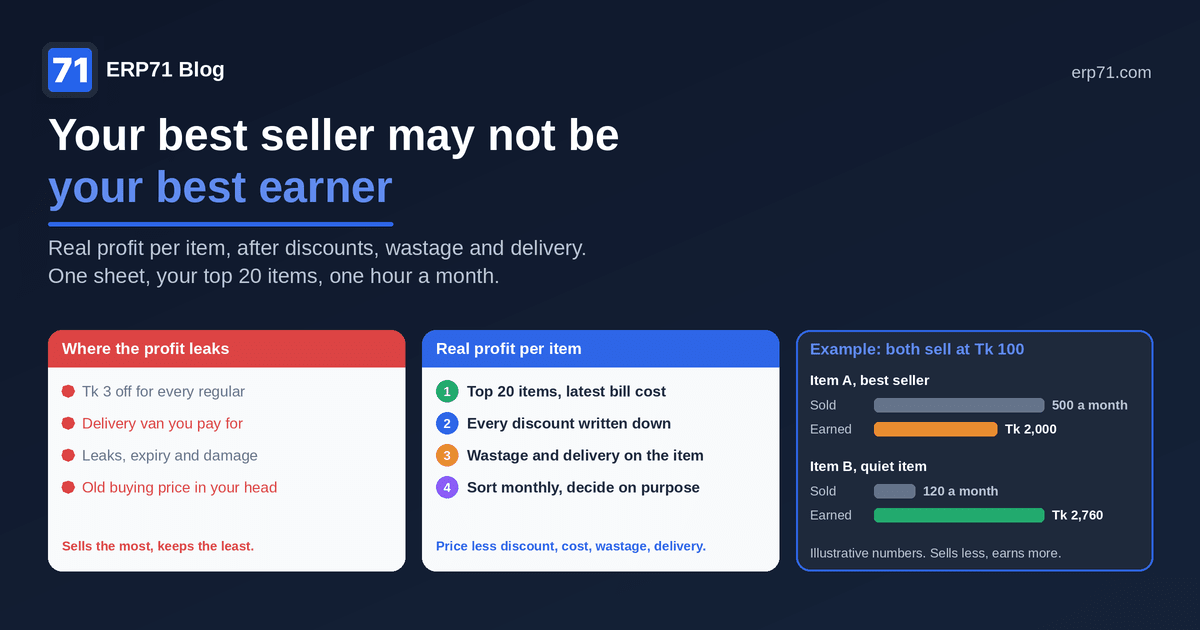
Item A is your best seller. You buy it for ৳90, so on paper you make ৳10. But regulars expect ৳3 off, delivery costs you about ৳2 per piece, and damage about ৳1. Real profit: ৳4. You sell 500 a month, so it brings in ৳2,000.
Item B is a quiet item. You buy it for ৳75, so on paper you make ৳25. Hardly anyone bargains on it and nobody asks for delivery. Say ৳1 goes in discounts and ৳1 in wastage. Real profit: ৳23. You sell only 120 a month, but it brings in ৳2,760.
The item that sells four times less earns more. Most shops have a few items like this, and the owner often has them the wrong way round.
Four habits for knowing real profit per item
You need one sheet, a month of honest notes and one hour at month end.
1. Start with your top 20 items and today's real buying cost.
Do not try every item. List the 20 that sell the most. For each one, write the selling price and the cost from the latest supplier bill, plus transport if you pay it. Not the price you remember.
2. Write down every discount, even the small ones.
The ৳20 you knock off for a regular, the free extra piece, the "round it off" at the counter. A mark on the memo is enough. At month end, add it up by item. Many owners are surprised which items carry most of the discount.
3. Put wastage and delivery on the item, not on "general expenses".
When something breaks, expires or comes back unsellable, note the item. When you deliver, note roughly what the trip cost and which items went. A bag of rice delivered across town for ৳150 is not the same item as the bag carried out of the shop.
4. Once a month, compare real profit per item and decide on purpose.
Take the selling price, then subtract the discount, the buying cost, the wastage and the delivery. That is real profit per piece. Multiply by pieces sold and sort the list. For a best seller with thin real profit, you have choices: tighten discounts, add a small delivery charge or minimum order, try another supplier or pack size, or keep it as the item that brings people in, knowing that is its job. For a quiet item with good real profit, give it better shelf space and never let it run out (stockouts and overstock).
What this is not
It is not full cost accounting. Rent and electricity stay in your monthly books (what real accounting means for one shop).
It also does not mean dropping your best seller. Some items earn little but bring in customers. That is fine, as long as it is a choice and not a surprise.
Soft close
When every sale, discount, return and supplier bill sits in one place, real profit per item is a report you open, not a weekend of adding up memos. Tools like ERP71 are built for that kind of one-shop clarity: what sold, at what price, after what discount, and what it really cost you.
Pick your top 20 this week. Start writing down the discounts and the damage. By next month end, you will know which items really carry your shop.