
Staff advances and salary: stop the notebook IOUs
Advances for Eid, a family emergency or lunch from the drawer are normal in a small shop. The trouble comes on salary day, when your number and your staff's number do not match. Five habits fix it: one advance register, a slip for every drawer advance, the cut agreed up front, a monthly salary sheet, and advances kept apart from loans and shop expenses.
Every small shop does it. A helper asks for ৳3,000 before Eid. Someone's mother is in hospital. A staff member needs a mobile recharge, or takes lunch money from the drawer and says "cut it from my salary".
You say yes, because that is how a decent shop runs. The trouble comes later.
The advance goes into a notebook, on the back of a memo, or nowhere. Weeks later it is salary day. You remember one number. Your staff member remembers another. Both of you are honest, and both of you feel cheated.
This is not about saying no to staff. It is about writing advances down so that salary day is a short sum, not an argument.
Why advances turn into salary-day fights
Advances are small, frequent and happen at busy moments. You hand over cash from the drawer while a customer is waiting. Nobody writes anything. At night the drawer is short, and you cannot say whether that is an advance, a counting mistake or something worse (cash in drawer vs bank).
The notebook does not save you either. "Karim 2000" with no date, no reason and no agreed cut is not a record. It is only a reminder.
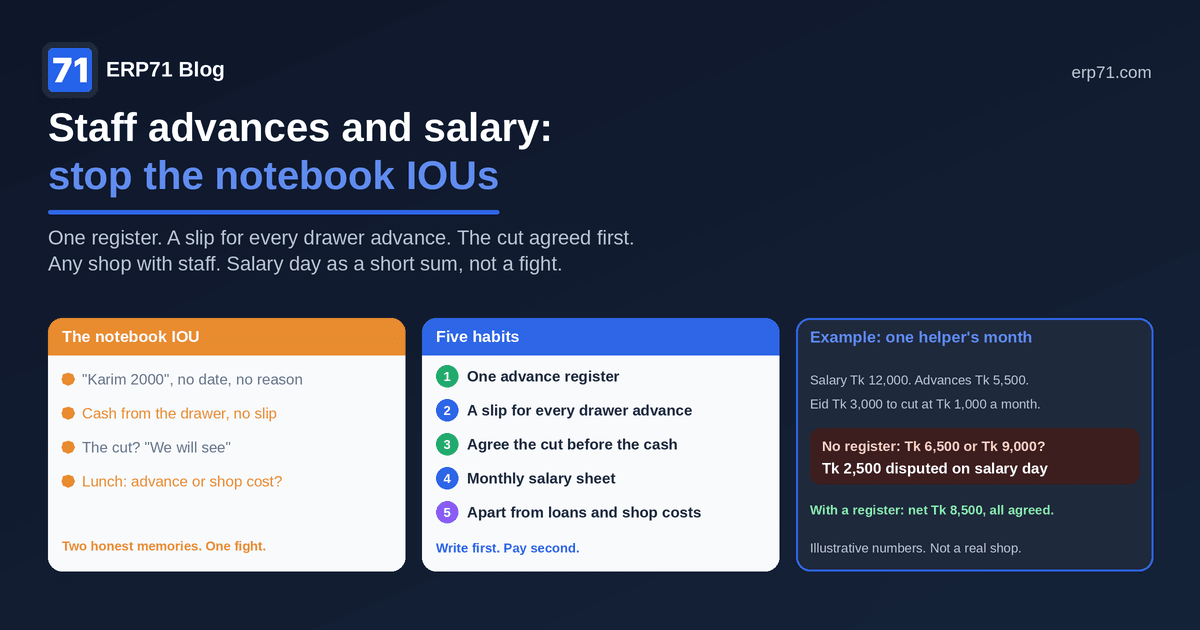
Here is a made-up example with round numbers. A helper earns ৳12,000 a month. This month he took a ৳3,000 Eid advance, with a spoken promise to cut ৳1,000 a month. Then ৳2,000 for his mother's medicine. Then about ৳500 in small bits: recharge, lunch, fare.
On salary day the owner wants to cut the full ৳5,500 and pay ৳6,500. The helper remembers ৳1,000 for Eid this month and ৳2,000 for the medicine, and thought the small bits were on the shop. He expects ৳9,000. Nobody has anything in writing. The gap is ৳2,500, and the real cost is trust.
With a simple register, the same month reads like this. Gross ৳12,000. Cut this month: ৳1,000 (Eid, first of three), plus ৳2,000 (medicine, agreed in full), plus ৳500 (small advances, each on a slip). Net paid ৳8,500. Eid balance of ৳2,000 carried to the next two months. Both sides can check it in a minute.
Five habits that stop the notebook IOUs
You need one register, a slip pad near the drawer, and the habit of writing first.
1. One advance register, one entry every time.
Keep one book or sheet only for staff advances. Each entry gets the date, the name, the amount, the reason, and how it will be cut. The staff member signs or initials it, or sends a WhatsApp line: "received ৳2,000". No entry, no advance.
2. Never from the drawer without a slip.
If the cash comes from the drawer, a small slip goes in its place: name, amount, date, initials. At closing the slip explains the gap, and next morning it is copied into the register. Your drawer count stays honest, and nobody is suspected over a shortage that was really an advance.
3. Agree the cut before you hand over the cash.
"৳1,000 a month for three months", said out loud and written in the register. Not "we will see". When the cut is agreed at the start, salary day is arithmetic, not negotiation.
4. One monthly salary sheet: gross, advances, deductions, net.
One line per person: gross salary, advances taken this month, amount cut this month, balance still due, net paid. Show each person their line before you pay, or hand it over as a salary slip. This sheet fits straight into your simple month-end close.
5. Keep advances apart from loans and shop expenses.
An advance is part of this month's salary paid early. A bigger loan, say for a wedding, gets its own page and repayment plan. Tea, lunch or travel for shop work is a shop expense, not an advance. Decide once which is which and tell your staff. Mixing them is how your profit number stops meaning anything (what real accounting means for one shop).
What this is not
It is not about distrust. Most advance arguments are between honest people with different memories. A written line protects the helper as much as the owner.
It is not legal advice either. Contracts and formal salary rules are a separate matter. If unsure, ask someone qualified.
And it is the same lesson as customer dues: what is not written down slowly stops being collected, and then it turns into a quarrel (due sales that never get collected). Like the weekly shelf check, it works because it is small and regular.
Soft close
When advances, salary and drawer cash sit in one record, salary day is a short check, not a dispute. Tools like ERP71 are built for that kind of one-shop clarity: who took what, when it gets cut, and what the drawer should hold tonight.
Start this week. Open one page called "Staff advances". Write down every amount still open, then ask each person to check and initial it. One honest page now beats a ৳2,500 argument on salary day.
See it on your own shop's data. Book a free 15-min demo on WhatsApp: https://app.erp71.com/s/hpmz2u