
When a supplier changes the price: catch it on the purchase memo
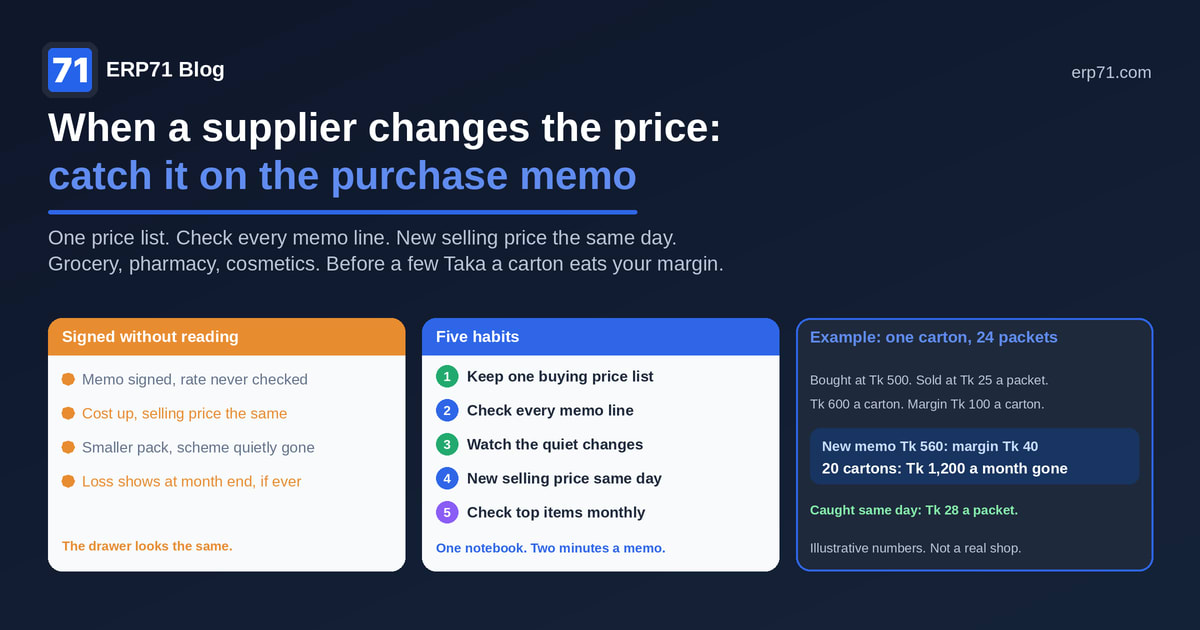
When a supplier raises a price and your selling price stays the same, the whole rise comes out of your margin, and the drawer will not tell you. In a made-up example, ৳60 more per carton on one item costs ৳1,200 a month. Keep one price list, check every memo line, watch for quiet changes, and update your selling price the same day.
The supplier's van has just left. You counted the cartons, signed the memo and put it in the drawer with the others.
Did any price change?
Most owners would say "I think it's the same." That is how margin disappears: not in one big loss, but a few Taka per carton, on a memo nobody read line by line.
Why a small price change hurts more than it looks
You set your selling price once and mostly forget it. Your buying price moves with the supplier, the season, a new company scheme, the cost of transport. When the buying price goes up and the selling price stays the same, the whole rise comes out of your margin (your best seller may not be your best earner).
And the drawer will not tell you. Sales look the same and customers are happy. The loss shows up at month end, if at all.
A made-up example in round numbers. Say you sell noodles by the packet, 24 packets to a carton:
- You buy the carton at ৳500
- You sell each packet at ৳25, so ৳600 a carton
- Margin: ৳100 a carton
The new memo says ৳560 a carton. Nobody notices, and you keep selling at ৳25.
- Margin now: ৳40 a carton
If you sell 20 cartons a month, the margin on this one item falls from ৳2,000 to ৳800. That is ৳1,200 a month gone, from one line on one memo. If three or four items go up the same month, that becomes a few thousand Taka, and you will not know which item did it.
Say you caught it the day the memo came and moved the packet to ৳28. That is ৳672 a carton, a margin of about ৳110. A few customers may grumble for a day, but you made the decision, not the memo.
Five habits that catch a price change on the day
One notebook, and two minutes with every memo.
1. Keep one price list for what you buy.
One page per supplier, or one notebook for the shop. For each item, write the last buying price and the date: the price on the last memo, not the one you remember.
2. Check every line of the memo before you sign or pay.
Quantity, rate, pack size, total. Compare each rate with your list. If you sent a written order, compare with that too (the WhatsApp order is not a purchase order). Circle any line that changed. If a rate looks wrong, ask the delivery man or call the sales rep right then, and write the answer on the memo.
3. Watch for the quiet changes, not only the rate.
Sometimes the rate stays the same and something else moves. The pack gets smaller. The free piece with every dozen disappears. A company scheme ends. A delivery charge appears at the bottom. Each of these is a price change, even when the number looks familiar.
4. Update your selling price the same day.
Decide the new selling price before the new stock reaches the shelf. Change the price tag or card, and tell every staff member who sells. If the price is printed on the pack and you cannot change it, at least you now know that item earns less, and can decide what to do. Either way, write the new selling price next to the new buying price in your list.
5. Once a month, look at your top items.
At month end (a simple month-end close), take your 10 or 15 fastest moving items and compare this month's buying price with last month's. If one supplier keeps moving prices up, ask for a better rate or get a second quote.
What this is not
It is not a fight with your supplier. Prices go up for real reasons, and a good supplier will explain a change if you ask. The point is to know on the day.
It is not a reason to buy big because someone said prices will rise. Three months of stock ties up cash and shelf space (why stockouts and overstock both kill cash).
It is not your full accounts, just a daily check that keeps your margin honest (what real accounting means for one shop). And not every rise has to go to the customer. Sometimes you hold a price on purpose to keep a regular. That is fine, as long as you chose it. Use the example only to see the pattern, then check your own memos.
Soft close
When purchase memos, buying prices and selling prices sit in one place, a changed rate shows up while you enter the memo, not at month end. Tools like ERP71 are built for that kind of one-shop clarity: what you paid last time, what you paid today, and what that does to your margin.
Start with this week's memos. Write the last buying price of your 20 most sold items on one page, and check every new memo against it. One careful week will show you where your margin has been leaking.