
Your daily break-even: the one number to check at closing
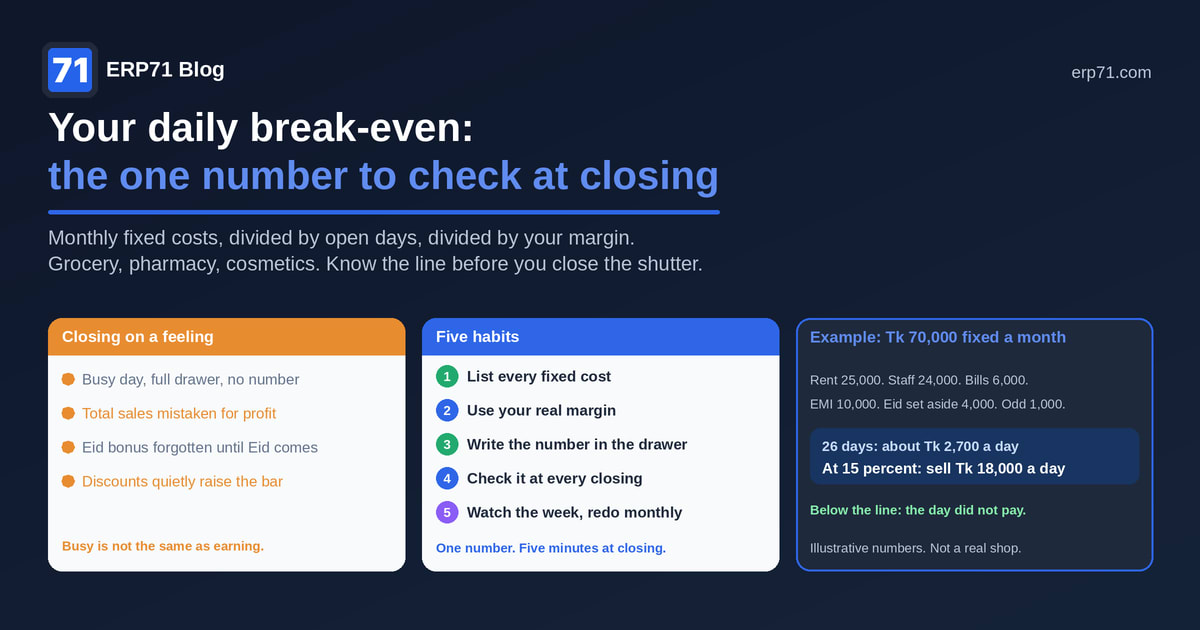
How much must your shop sell each day just to cover rent, salaries and bills? Add up the monthly fixed costs, divide by the days you open, then divide by your average margin. In a made-up example that is ৳18,000 a day. Write the number inside the drawer, check it at every closing, look at the week, and redo it whenever a cost changes.
It is 10 at night and you are closing the shutter. The day felt busy. The drawer looks full and a few bKash payments came in.
But was today a good day, or did it only feel like one?
Most owners answer with a feeling. There is a simpler way: one number, worked out once a month, that tells you how much you must sell each day to cover rent, salaries and bills. That number is your daily break-even.
Below it, the day cost more than it paid. Above it, the day earned.
Why a busy day can still be a losing day
Sales are not profit. When you sell ৳1,000 of goods, most of it goes back to the supplier. You only keep the margin, the gap between what you paid and what you sold for (your best seller may not be your best earner).
Rent, salaries and bills come out of that margin, not out of total sales. So the real question at closing is not "how much did I sell?" but "did today's margin cover today's share of the fixed costs?"
A made-up example in round numbers. Say your shop's monthly fixed costs look like this:
- Rent: ৳25,000
- Two staff at ৳12,000 each: ৳24,000
- Electricity, internet, phone and other bills: ৳6,000
- Loan EMI: ৳10,000
- Eid bonus set aside: ৳4,000 (one month's salary for each staff at both Eids is ৳48,000 a year, so put aside ৳4,000 every month)
- Small repairs and odd costs: ৳1,000
That is ৳70,000 a month. If the shop is open 26 days, each day has to carry about ৳2,700 of fixed cost.
Now the margin. Say that across everything you sell, you keep about 15 percent. To earn ৳2,700 of margin, you need to sell ৳2,700 divided by 0.15, which is ৳18,000.
So in this example, ৳18,000 is the daily break-even. Sell ৳15,000 and the margin is about ৳2,250, roughly ৳450 short. Sell ৳22,000 and the margin is about ৳3,300, roughly ৳600 above the line.
Watch discounts. If heavy offers push your average margin down to 12 percent, the same costs need about ৳22,500 a day. Busier, but harder.
Five habits that keep the number honest
One sheet of paper and five minutes at closing.
1. Write every monthly fixed cost on one list.
Rent, salaries, bills, EMI. Then the costs that come only a few times a year, like the Eid bonus, yearly renewals or a fridge repair: divide them by 12 and add them every month. If your family lives on what you take home from the shop, add that amount too. Otherwise the shop "breaks even" while your household pays.
2. Use your real average margin, not a hopeful one.
Pick a normal month. Compare what you paid suppliers for the goods you sold with what you sold them for. A rough figure from your purchase memos beats a guess. Low margin items like rice or oil pull the average down, so be honest.
3. Write the number where you close.
On the first page of the cash book, or on a card taped inside the drawer: "Daily target: ৳18,000." When the number is in front of you every night, you stop guessing.
4. Check it at closing, every day.
Count cash, bKash and Nagad, add the due sales of the day, and write the total next to the target. Mark it above or below. Count the drawer properly first (cash in the drawer is not money in the bank).
5. Look at the week, and redo the number every month.
One slow Tuesday means nothing. Four below-target days in a week means something. At month end, when you close the books (a simple month-end close), check the list again. If rent went up or a loan ended, work out the new number the same day.
What this is not
It is not profit. Hitting it means the day paid its own costs. The earning starts above the line.
It is not cash either. A sale on due counts toward the target, but the money is not in your hand until the customer pays (due sales that never come back).
It is not your full accounts, just one rough number for daily decisions (what real accounting means for one shop). And it is not a reason to panic on one bad day. Use the example only to see the pattern, then do the sum with your own figures.
Soft close
When sales, margins and costs sit in one place, the daily break-even stops being a sum on the back of a memo and becomes a line you see at closing. Tools like ERP71 are built for that kind of one-shop clarity: what you sold today, what you kept, and how far you are from the line.
Start this week. Make the list of fixed costs, work out your number tonight, and write it inside the drawer. Check it at every closing for seven days. One honest week will tell you more than a year of feelings.
See it on your own shop's data. Book a free 15-min demo on WhatsApp: https://app.erp71.com/s/sn3f43