
Supplier dues calendar: who you owe, how much and when
When supplier dues live in your head or on the back of memos, you pay late, pay twice or get caught short on the day. In a made-up example, ৳1,00,000 due in one week against ৳80,000 of free cash is easy to fix if you see it on Sunday. Keep one page of dues by date, match every payment to a memo, and check the next seven days every week.
It is Thursday afternoon. A sales rep walks in and says, "Bhai, last month's ৳45,000 is due today."
Is it? Did you already pay part of it? Is there another supplier due this week too?
Most owners keep supplier dues in their head, on the back of memos, or in a notebook that only one person understands. That works until two suppliers come on the same day, or one says you never paid.
Why supplier dues go wrong
Credit from suppliers is a good thing. It lets you sell the goods before you pay for them. But when nobody writes down who is owed what and when, three things happen.
You pay late. The supplier gets annoyed, the next delivery is slow, or the scheme you were promised quietly disappears.
You pay twice. You gave cash to the delivery man without a receipt, and the sales rep's book still shows it unpaid. Without a record, you pay it again to keep the peace.
You get caught short. All the big dues land in the same week, and you find out on the day, with not enough cash in the drawer (cash in the drawer is not money in the bank).
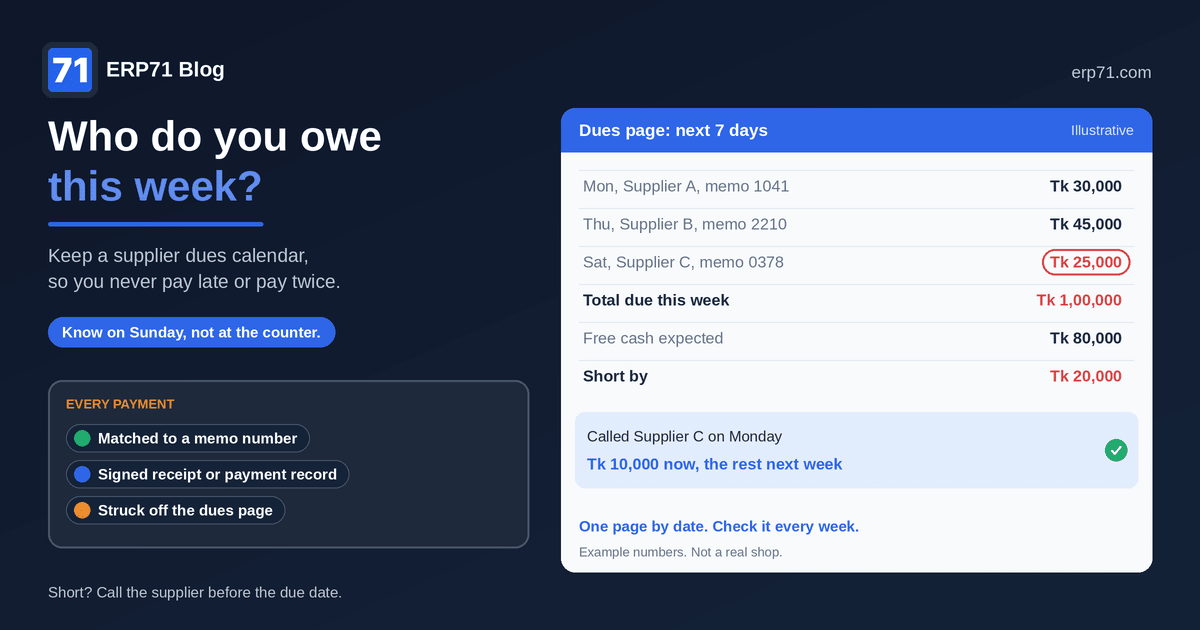
A made-up example in round numbers. Say this is your coming week:
- Supplier A: ৳30,000 due Monday
- Supplier B: ৳45,000 due Thursday
- Supplier C: ৳25,000 due Saturday
- Total due: ৳1,00,000
After rent, salaries and daily costs, you expect about ৳80,000 of free cash this week. You are ৳20,000 short.
If you see this on Sunday, you have options. You call Supplier C on Monday, explain, and ask to pay ৳10,000 now and the rest next week. Most suppliers will agree when you ask early. If you find out on Saturday, when the rep is standing at the counter, your only choices are an awkward excuse or a quick loan.
Five habits for a supplier dues calendar
One page, and ten minutes a week.
1. Keep one page of what you owe, sorted by date.
For every unpaid memo, write the supplier, the memo number, the amount and the due date. Keep it in date order, so the next due is always at the top. If you buy on a written order, the memo number ties it back to what you ordered (the WhatsApp order is not a purchase order).
2. Match every payment to a memo, with a receipt.
When you pay, get a signed receipt or a bank or mobile payment record. Write on the memo itself: paid, date, amount, receipt number. Then strike it off your dues page. A payment that is not matched to a memo is the one you end up paying twice.
3. Look at the next seven days every week.
Pick one day, say Saturday night or Sunday morning. Add up everything due in the next seven days and compare it with the cash you expect to have after daily costs (your daily break-even). If the numbers do not fit, you know now, not on the day.
4. If you will be short, call before the due date.
Choose which supplier you can ask for more time, call early, and agree a new date and amount. Write the new date on your dues page. A supplier who hears from you first is far more flexible than one who has to chase you.
5. Once a month, check your balance with each supplier.
At month end (a simple month-end close), ask each regular supplier for their statement, or read their rep's book with them, and compare it with your dues page. Sort out any difference while both of you still remember the memo.
What this is not
It is not a reason to delay every payment as long as possible. Paying on time is what keeps your credit and your schemes.
It is not your full accounts, just a simple list that tells you who to pay and when (what real accounting means for one shop).
And it does not replace a clear head before a busy season. Before Eid or a festival week, the dues page is the first thing to look at (festival week prep). Use the example only to see the pattern, then write down your own dues.
Soft close
When purchase memos, supplier payments and daily sales sit in one place, you can see what you owe this week next to what you are likely to take in, and every payment is already tied to its memo. Tools like ERP71 are built for that kind of one-shop clarity: who you owe, how much, and when.
Start tonight. Take every unpaid memo out of the drawer, write them on one page in date order, and add up the next seven days. You will know exactly where you stand before the next rep walks in.
See it on your own shop's data. Book a free 15-min demo on WhatsApp: https://app.erp71.com/s/4ywumn